
The world of technology is evolving faster than ever, and at the heart of this evolution lies 5G, the fifth generation of mobile networks. Promising lightning-fast speeds, ultra-low latency, and unprecedented connectivity, 5G is not just an upgrade—it’s a revolution. Understanding the future of 5G technology is essential as it is set to transform industries, lifestyles, and digital experiences. In this article, we explore the transformative potential of 5G, its applications across industries, and how it is shaping the future of 5G technology in our daily lives.
What is 5G?
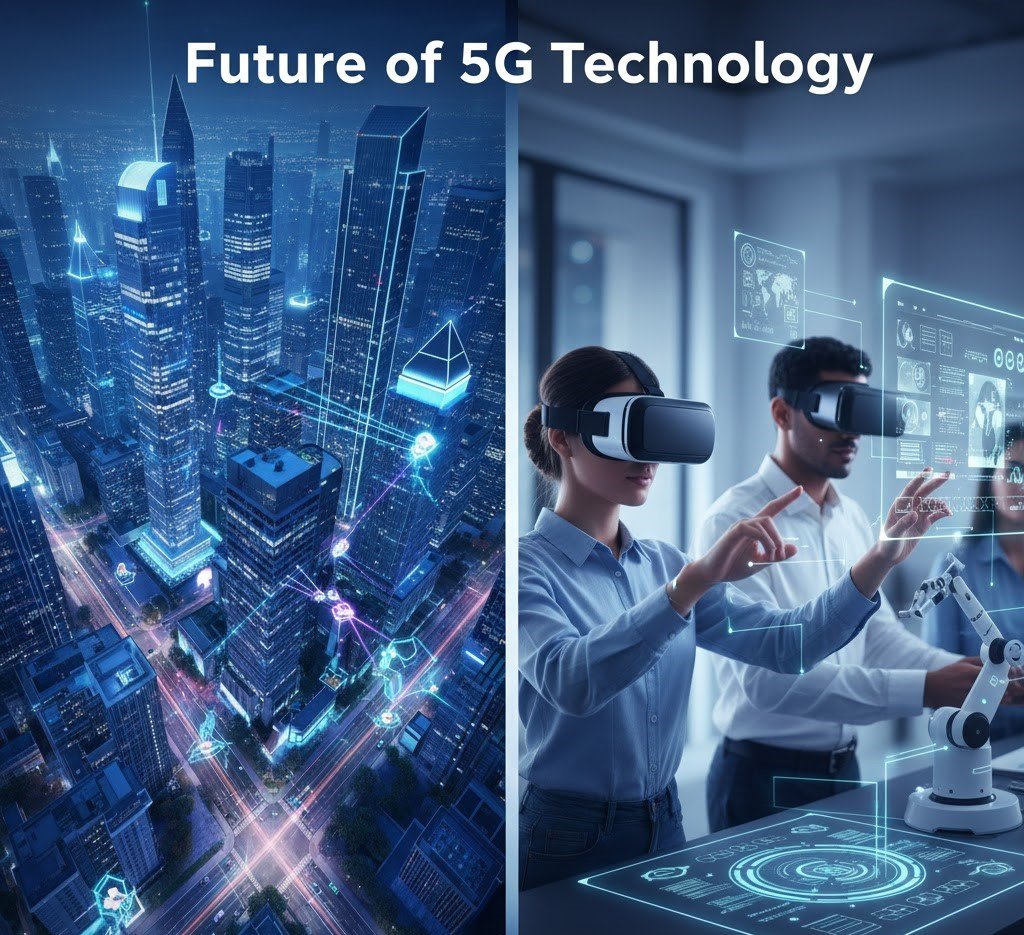
Before diving into its possibilities, let’s clarify what 5G really is. In simple terms, 5G is the next generation of wireless technology following 4G LTE. It is designed to:
- Deliver speeds up to 100 times faster than 4G.
- Reduce latency (the delay between sending and receiving data) to as low as 1 millisecond.
- Support massive device connectivity, making the Internet of Things (IoT) seamless.
- Enable new applications like virtual reality (VR), augmented reality (AR), autonomous vehicles, and smart cities.
Unlike 4G, which mainly focused on faster internet for smartphones, 5G aims to redefine human experiences. The future of 5G technology is not just about speed—it’s about how connectivity can transform society.
How Fast is 5G Really?
Speed is one of the most talked-about features of 5G. While 4G provides average speeds of 20-50 Mbps, 5G can offer theoretical speeds of up to 10 Gbps. This means you could download an entire HD movie in seconds. But speed alone doesn’t capture the full potential. The future of 5G technology lies in its low latency, enabling real-time communication for self-driving cars, remote surgeries, and immersive gaming—applications that were nearly impossible with 4G.
5G in Everyday Life
Many people wonder how 5G will affect their daily lives. Here are some practical examples demonstrating the future of 5G technology:
1. Enhanced Mobile Experience
With 5G, smartphones become faster and more reliable. Video calls are smoother, streaming in 4K or even 8K becomes seamless, and large files download almost instantly. The future of 5G technology ensures mobile experiences are smoother than ever, whether you’re gaming, browsing, or working on the go.
2. Smart Homes and IoT
5G can connect billions of devices simultaneously. From smart fridges and thermostats to security cameras and wearables, the future of 5G technology makes the Internet of Things more efficient. Your home could evolve into a fully interconnected ecosystem that reacts intelligently to your habits and needs.
3. Augmented Reality and Virtual Reality
The future of 5G technology brings immersive AR and VR experiences into everyday life. Virtual shopping, real-time gaming, and remote education all benefit from low latency, making interactions smooth and realistic. Architects can walk clients through virtual buildings before construction, and surgeons can perform precise operations remotely.
5G in Industry and Business
The true power of 5G extends far beyond consumer applications. Industries around the globe are adopting 5G to boost productivity, innovation, and efficiency—a core aspect of the future of 5G technology.
1. Autonomous Vehicles
Self-driving cars rely on instant communication with other vehicles, traffic signals, and cloud systems. The future of 5G technology ensures low-latency communication for safe, efficient autonomous driving. Eventually, traffic jams could become a thing of the past as connected vehicles optimize routes dynamically.
2. Healthcare Revolution
The future of 5G technology is transforming healthcare with remote surgeries, telemedicine, and AI-powered diagnostics. Doctors can perform surgeries from thousands of miles away, and patients in rural areas can access expert care without traveling.
3. Manufacturing and Industry 4.0
Factories are becoming smarter with 5G-powered automation, a key component of the future of 5G technology. Sensors, robots, and machines communicate seamlessly to optimize production lines, reduce downtime, and increase efficiency. Predictive maintenance and AI-driven analytics are revolutionizing manufacturing.
4. Entertainment and Media
5G is changing how we consume content. The future of 5G technology enables higher-quality streaming with zero buffering, virtual concerts with AR experiences, and cloud gaming accessible without expensive hardware. Entertainment is shifting toward interactive, real-time experiences.
5G and Smart Cities
One of the most exciting prospects is the rise of smart cities. These cities use connected sensors and devices to manage traffic, energy, waste, and public safety efficiently. Examples include:
- Smart traffic lights adjusting flow based on real-time data.
- Energy-efficient buildings optimizing lighting, heating, and cooling.
- Connected public services for waste management, street lighting, and emergency response.
The future of 5G technology is making smart cities not just concepts but realities in countries like South Korea, Singapore, and parts of Europe.
Economic Impact of 5G
The economic potential of 5G is enormous. Industry reports predict that 5G could contribute trillions of dollars to the global economy over the next decade. Businesses adopting the future of 5G technology can improve efficiency, create new revenue streams, and offer innovative services. Consumers benefit from faster internet, better services, and improved quality of life.
Challenges and Concerns
Despite its benefits, 5G faces challenges:
1. Infrastructure Costs
Deploying 5G requires dense networks of small cell towers. Building this infrastructure is expensive and time-consuming, delaying the future of 5G technology in some regions.
2. Security and Privacy
With billions of connected devices, cybersecurity risks increase. Data breaches, hacking, and privacy concerns must be addressed for safe adoption of the future of 5G technology.
3. Health Concerns
Some worry about 5G radiation. While studies indicate it is safe, public skepticism persists, affecting the perception of the future of 5G technology.
4. Digital Divide
Rural areas may lag behind urban centers, creating a digital divide that impacts the adoption of the future of 5G technology globally.
The Future: Where 5G is Taking Us
The future of 5G technology promises a hyper-connected world:
- Billions of devices communicating in real-time.
- Revolutionized industries like healthcare, transportation, and entertainment.
- Immersive AR, VR, and cloud gaming experiences.
- Autonomous cars, drones, and robotics operating efficiently.
- Global economic growth fueled by innovation, startups, and job creation.
In short, the future of 5G technology is more than faster internet—it’s the backbone of a smarter, more connected, and innovative world.
Conclusion
5G is more than an upgrade—it’s a gateway to the future of 5G technology. It transforms everyday life, revolutionizes industries, and creates opportunities for a smarter, more connected world. While challenges like infrastructure, security, and accessibility exist, the benefits far outweigh the obstacles. As 5G continues to roll out, the future of 5G technology will redefine how we live, work, and interact with the digital world.
The question is not just where 5G is taking us, but how ready we are to embrace the future of 5G technology. With the right infrastructure, policies, and innovation, the 5G era promises to connect people and devices in ways we could only imagine a decade ago.
