
The digital marketing landscape is evolving faster than ever. SEO vs GEO 2026 strategies are becoming crucial for online visibility. Search engine optimization (SEO) has long been the cornerstone of digital marketing, but in 2026, the rise of GEO-targeted search strategies is transforming how brands connect with their audience. Understanding the nuanced differences between SEO and GEO, and adapting to the latest trends, is vital for businesses aiming to stay competitive.
In this article, we will explore 9 essential shifts in SEO vs GEO 2026 strategies that marketers and website owners must embrace to boost traffic, increase rankings, and maximize revenue potential.
1. From Global SEO to Hyperlocal GEO Targeting
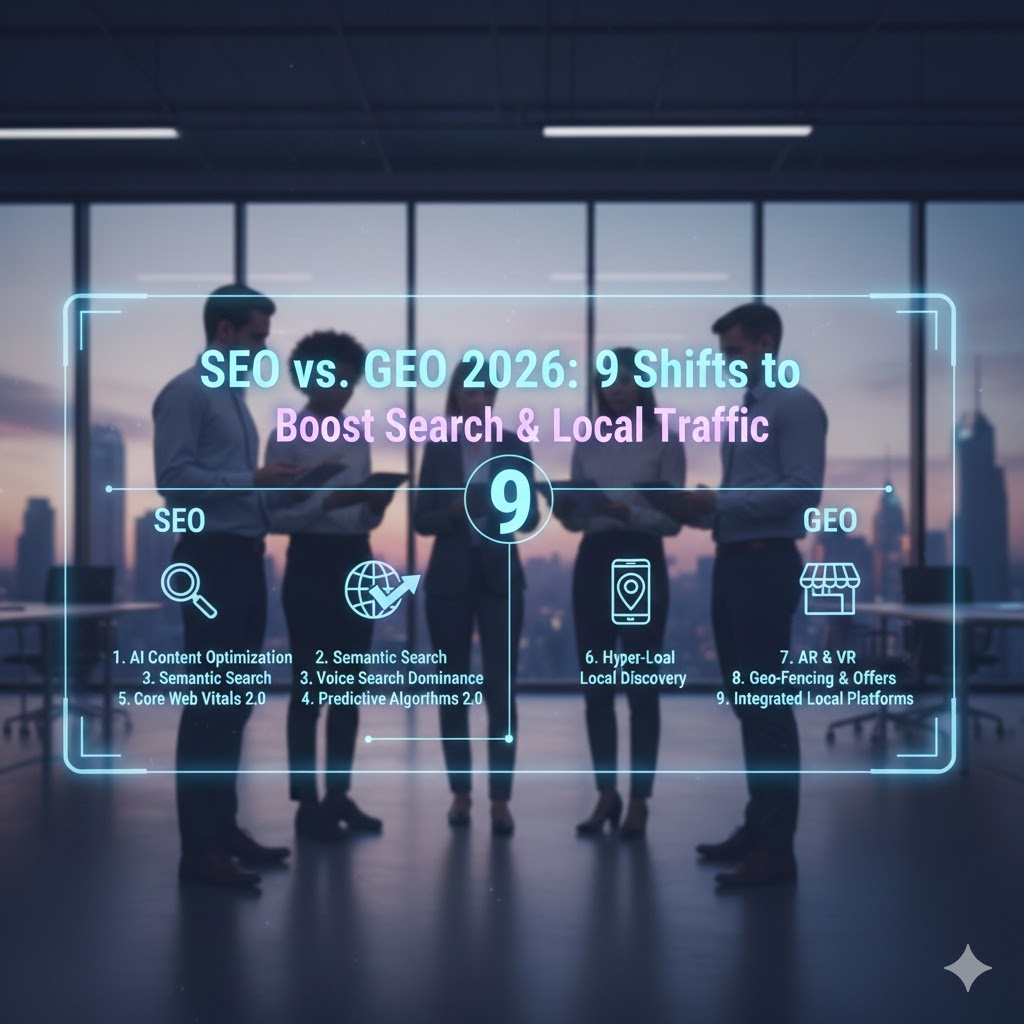
Traditionally, SEO focused on global or broad keyword optimization, prioritizing rankings on search engines for a wide audience. In 2026, this approach is evolving into hyperlocal GEO targeting, making SEO vs GEO 2026 a key consideration for marketers.
Search engines like Google increasingly emphasize user location in delivering results. A user in New York searching for “best coffee shop” expects results within a few miles of their location, not a national list.
Key Takeaways:
- Use Google My Business and other local directories to optimize GEO presence.
- Include location-specific keywords in meta tags, titles, and headings.
- Leverage schema markup for local businesses to boost visibility.
Hyperlocal strategies increase conversion rates, as users searching locally are often ready to act. This is a major reason why SEO vs GEO 2026 strategies are more important than ever.
2. Voice Search Optimization Changes Everything
Voice search is no longer futuristic—it’s mainstream. With smart assistants like Alexa, Siri, and Google Assistant, search queries have become conversational and location-specific.
SEO Implications:
- Focus on long-tail keywords and question-based queries.
- Include natural language phrases in your content.
GEO Implications:
- Optimize for “near me” searches, which have grown exponentially.
- Use structured data to make local businesses voice-search-friendly.
By 2026, nearly 60% of searches are expected to be voice-based. Businesses ignoring SEO vs GEO 2026 voice search integration risk losing visibility in local and global searches.
3. AI-Driven Search: Personalized Results
Artificial Intelligence (AI) is redefining search results. Search engines now prioritize user intent, behavior, and location over generic keywords.
SEO Shift:
- Content must focus on solving problems and providing value, not just stuffing keywords.
- AI-driven tools like GPT-powered content assistants can help identify search intent patterns.
GEO Shift:
- Location signals are critical. Search engines use AI to predict which local businesses a user is likely to prefer.
- Ensure your business information is consistent across NAP (Name, Address, Phone) citations.
By integrating AI insights with GEO strategies, businesses can appear in high-intent local searches. This approach demonstrates the future of SEO vs GEO 2026.
4. Mobile-First Dominance
Mobile search dominates, with devices accounting for over 60% of searches globally. Both SEO and GEO strategies need to prioritize mobile experiences.
SEO Best Practices:
- Use responsive design to ensure your website adapts to all screen sizes.
- Improve page speed, as Google ranks faster-loading sites higher.
GEO Best Practices:
- Optimize local landing pages for mobile.
- Incorporate click-to-call buttons, maps, and directions.
Mobile users often perform location-specific searches, making SEO vs GEO 2026 mobile optimization essential for visibility.
5. Local Reviews: The New Ranking Currency
In 2026, user reviews are more influential than backlinks for GEO rankings. Positive reviews signal trustworthiness and relevance to search engines.
SEO Perspective:
- Encourage satisfied customers to leave reviews on Google, Yelp, and industry-specific platforms.
- Respond to reviews promptly to show engagement.
GEO Perspective:
- Local businesses with higher ratings rank better in local packs.
- Highlight geo-specific testimonials to appeal to nearby users.
Managing reviews effectively is a key component of SEO vs GEO 2026, boosting visibility, credibility, and conversion rates.
6. Visual and Video Search Are Game Changers
Visual search is booming. Tools like Google Lens and AI image recognition allow users to search using images instead of text. Video content is equally influential, as YouTube remains the second-largest search engine.
SEO Implications:
- Optimize images with alt tags, descriptive filenames, and structured data.
- Embed transcripts for video content to boost SEO.
GEO Implications:
- Share location-specific images and videos to increase local engagement.
- Use video to showcase physical stores, products, or services for nearby users.
Visual content plays a major role in SEO vs GEO 2026, driving traffic and engagement from multiple channels.
7. Semantic Search and Intent Optimization
Keyword stuffing is dead. Modern search engines use semantic analysis to understand user intent, which affects both global SEO and local GEO strategies.
SEO Strategy:
- Focus on topic clusters rather than isolated keywords.
- Answer user questions comprehensively.
GEO Strategy:
- Include location-based intent naturally within content.
- Example: “Affordable pizza delivery in Brooklyn” instead of just “pizza.”
Understanding intent is essential for SEO vs GEO 2026, helping businesses connect with the right audience at the right time.
8. Zero-Click Searches: Capture Attention Quickly
The rise of zero-click searches (featured snippets, knowledge panels, local packs) means users often get answers without visiting a website.
SEO Approach:
- Optimize for featured snippets by structuring content with headers, bullet points, and concise answers.
- Use FAQ pages to target common queries.
GEO Approach:
- Optimize Google Business Profiles with photos, services, and posts.
- Ensure NAP consistency so local packs accurately reflect your business.
By 2026, zero-click searches will account for a majority of queries. Businesses integrating SEO vs GEO 2026 strategies can maintain visibility even in these scenarios.
9. Integrated SEO + GEO Strategy Is Non-Negotiable
The integration of SEO and GEO strategies is essential. Businesses can no longer view global SEO and local GEO as separate efforts.
Why Integration Matters:
- Users expect a seamless experience, whether searching globally or locally.
- Search engines reward comprehensive content addressing both relevance and location.
Actionable Tips:
- Create location-specific landing pages for each city or region.
- Combine global keyword strategy with local modifiers.
- Track performance using analytics segmented by location.
- Update content regularly to reflect local events, trends, and news.
Integrated strategies define the core of SEO vs GEO 2026, improving rankings, user experience, and ROI.
Conclusion: The 2026 Search Landscape
In 2026, search is more personalized, local, and AI-driven than ever. SEO and GEO are no longer separate strategies—they’re two sides of the same coin. The future of search is location-aware, user-focused, and content-rich. Marketers who adapt now with SEO vs GEO 2026 strategies will enjoy higher rankings, increased visibility, and stronger engagement in the rapidly evolving digital ecosystem.
